12 Haptic Feedback Integration Challenges and Solutions in Robot Pets
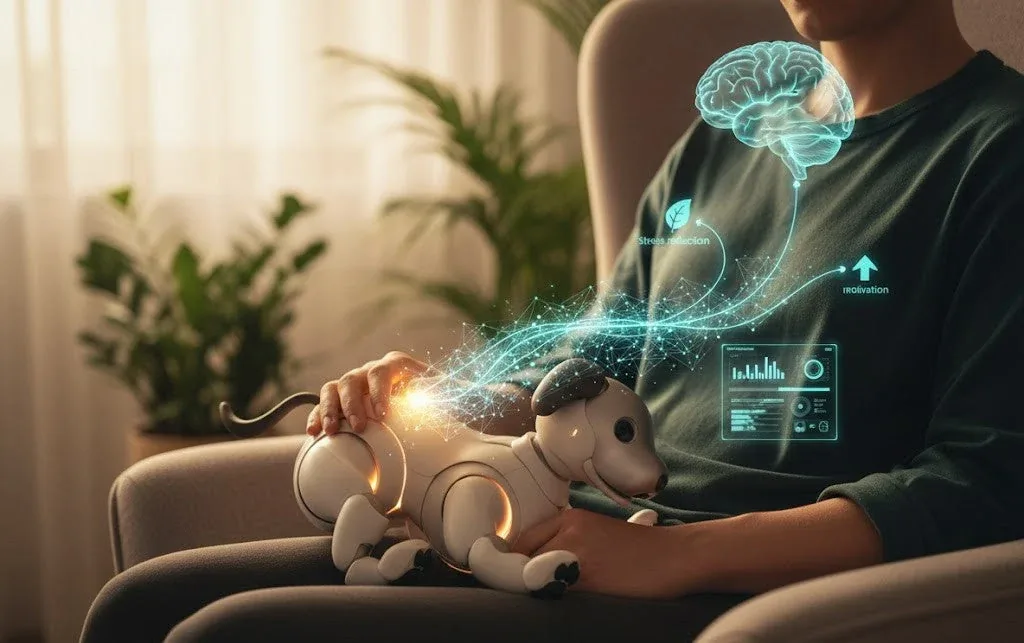
Haptic feedback integration in robot pets has a deceptively difficult goal: when you touch a robotic companion, its response should make sense.
Pet its head, and it might lean toward your hand. Stroke its back, and it could produce a gentle vibration that resembles purring. Squeeze too firmly, and it might pull away. Some designs can go further by generating warmth, movement, pressure, or other physical sensations that reinforce the impression that the robot is aware of your touch.
Making those interactions convincing requires much more than putting vibration motors under synthetic fur. Robot pets have limited interior space, finite battery capacity, moving components, embedded processors, sensors, and materials that need to withstand repeated physical contact.
The real engineering challenge is coordinating all of those systems quickly and subtly enough that the user stops thinking about the technology underneath.
Why Haptic Feedback Matters in Robot Pets
A robot pet can communicate through sound, movement, lights, facial features, or a screen, but touch occupies a particularly important role because pet-like interaction is inherently physical.
People instinctively reach out to pet, pat, scratch, hug, or hold an animal-shaped robot. If nothing happens, the interaction can feel incomplete. If the robot responds appropriately, the same touch becomes a two-way exchange.
Haptic feedback helps close that loop. The robot first needs to detect physical contact. Its software then interprets what happened and selects a response. Motors or other actuators create movement or tactile feedback, while behavioral software may simultaneously trigger sounds, posture changes, or other reactions.
The process can be represented simply as: Touch → sensing → interpretation → behavioral decision → physical response
Every stage introduces potential errors. A realistic haptic experience therefore depends less on any single component than on how well the entire loop works together.
Challenge 1: Detecting Human Touch Accurately
Before a robot pet can respond naturally, it needs to understand where and how it’s being touched.
Simple contact switches can detect that something happened, but natural petting contains much more information. A person might lightly stroke the robot’s back, scratch behind its ear, tap its head, squeeze its paw, or hug its body. Those actions can involve different locations, pressures, durations, and directions.
Capacitive touch sensors can help detect contact, while pressure or force sensors can provide information about how strongly someone is touching the robot. Flexible and distributed sensor arrays can potentially capture interactions across larger sections of the body.
The challenge is obtaining enough information without turning the robot’s exterior into a dense, expensive network of sensors. More sensors increase wiring, processing requirements, calibration complexity, power consumption, and potential failure points. Designers therefore need to decide where touch information provides the greatest behavioral value.
A robot pet doesn’t necessarily need equally precise sensing across its entire body. Designers can identify high-interaction zones by studying how users naturally handle the robot. The head, back, chin, ears, paws, and sides may receive much more contact than areas such as the underside or tail base, depending on the robot’s form. Higher-resolution sensing can then be concentrated in those areas.
Software can also help infer gestures from multiple sensor readings. If adjacent sensors activate sequentially along the robot’s back, for example, the system may interpret the pattern as a stroke rather than several unrelated touches. This approach can provide richer interaction without requiring every square inch of the exterior to function as an independent touch sensor.
Challenge 2: Distinguishing Different Types of Touch
Detecting contact isn’t enough. A responsive robot pet needs some understanding of what that contact means. Consider a sensor registering pressure on the robot’s head for two seconds. Was the user gently resting a hand there? Pressing down? Scratching repeatedly? Picking up the robot? Raw sensor values don’t answer those questions on their own.
Touch interpretation requires software to evaluate patterns over time. Duration, pressure, location, direction, repetition, and combinations of sensor inputs can all contribute to gesture classification.
Machine learning can also be used to recognize more complex interaction patterns when sufficient training data is available. Instead of relying entirely on fixed thresholds, a model can classify patterns associated with petting, tapping, squeezing, scratching, or holding.
The trade-off is complexity. A sophisticated classifier may improve recognition while demanding more processing power, training data, validation, and computational resources.
For many consumer robot pets, a hybrid system can make sense. Straightforward interactions can use reliable rule-based thresholds, while more ambiguous gestures can be handled by more advanced classification.
Challenge 3: Making Haptic Responses Feel Natural
Detecting touch solves only half the problem. The robot must respond in a way that feels appropriate. A basic vibration motor can provide clear confirmation that touch has been registered, but constant buzzing rarely resembles interaction with an animal. Naturalistic feedback needs variation.
A purr-like sensation, for example, may require a soft repeating vibration rather than a sharp pulse. A contented reaction could involve a subtle body movement combined with low-frequency tactile feedback. A startled response might be shorter and more abrupt.
This means engineers need to think in terms of haptic patterns rather than simply turning actuators on and off. Amplitude, frequency, duration, rhythm, ramp-up, and ramp-down can all change how a sensation is perceived.
Context matters too. The same vibration may communicate something completely different depending on whether the robot is being stroked, picked up, or squeezed.
Haptic feedback becomes more believable when it agrees with the robot’s other behaviors. Imagine stroking a robot pet’s head. The internal actuator creates a gentle purring sensation, but the robot simultaneously jerks its head away and produces an alarm sound. Each system may work correctly on its own, yet the combined interaction feels incoherent.
Better integration coordinates touch with movement, sound, visual expression, and behavioral state. A pleasant stroke could trigger a subtle vibration, relaxed posture, head movement toward the hand, and an appropriate sound. A rough interaction might cause the robot to move away while producing a different tactile response.
Synchronizing these channels gives the user multiple signals that communicate the same underlying state. This is closely connected to the broader challenge of designing believable emotional responses in robot pets, because tactile feedback works best when it supports a consistent behavioral personality.
Challenge 4: Haptic Latency Can Break the Illusion
Timing has a major influence on perceived responsiveness. When someone touches a robot, and the tactile or behavioral reaction occurs noticeably later, the response can feel disconnected from the action that caused it.
Latency can accumulate at several points. Sensors need to collect data, processors need to interpret it, behavioral software needs to decide what should happen, and actuators need time to produce the physical response. Complex systems may add networking delays if processing depends on cloud services or communication with a companion device.
For immediate tactile interactions, local processing has a major advantage. Basic touch recognition and time-sensitive haptic responses can run directly on the robot instead of waiting for a remote system. More computationally intensive tasks can still happen elsewhere when appropriate. This creates an edge-processing architecture in which immediate physical interactions remain local while less time-sensitive functions can use additional computing resources.
Challenge 5: Actuators Compete for Limited Space
Robot pets already contain a crowded collection of components. Motors may control the head, legs, ears, tail, eyes, or body. Batteries occupy valuable internal volume. Speakers, processors, circuit boards, sensors, cooling considerations, and structural components compete for the remaining space. Haptic actuators have to fit somewhere inside that architecture.
Placement matters because tactile energy needs to reach the user’s hand. An actuator buried beneath thick padding may require more power to produce a noticeable sensation. Place it too close to a rigid shell, and the vibration may spread through the entire robot instead of remaining localized.
Mechanical isolation can help. Engineers can use structural features and compliant materials to limit unwanted vibration transmission. Rather than relying on one powerful actuator for the whole body, several smaller actuators can provide localized feedback in high-value interaction zones. The result can feel more precise while potentially reducing unnecessary vibration.
Challenge 6: Soft Materials Can Interfere With Haptic Performance
Robot pets often need soft exteriors because users expect them to be comfortable to touch. Synthetic fur, foam, silicone, fabric, and flexible polymers can make the robot feel less like a machine. Those same materials can complicate sensing and feedback.
Thick padding may reduce the sensitivity of touch sensors. Soft layers can absorb vibration before it reaches the user’s hand. Stretching, compression, moisture, and repeated cleaning can also affect embedded sensors and wiring. The mechanical stack therefore needs to be designed as a system.
Engineers must consider the outer covering, padding, sensor layer, structural shell, and actuator together rather than treating the exterior as decoration added after the electronics are finished.
Material thickness can be varied across the body. Areas intended for detailed tactile interaction may use thinner or more responsive layers, while other regions can prioritize softness and durability. This is one area where industrial design and haptic engineering need to develop together from the beginning.
Challenge 7: Haptic Feedback Consumes Battery Power
Every physical response requires energy. Vibration motors, linear actuators, heating elements, movement systems, sensors, processors, speakers, and wireless communication all draw from the same battery. A robot that reacts physically to every minor touch can quickly waste energy on interactions the user barely notices.
Efficient haptic design therefore requires prioritization. The system can distinguish between incidental contact and meaningful interaction before activating energy-intensive feedback. A brief brush against the robot while carrying it, for example, may not require the same response as several seconds of deliberate petting.
Actuator selection matters as well. Different haptic technologies offer different trade-offs in power consumption, response speed, output, size, and control. Software can further reduce energy use by limiting unnecessary actuator duration and avoiding excessive feedback intensity. Adaptive power management can even adjust haptic behavior according to battery level, preserving core interaction while reducing less essential effects as the battery approaches depletion.
Challenge 8: Mechanical Noise Can Ruin a Subtle Interaction
A robot pet may technically create the correct tactile sensation while producing enough mechanical noise to destroy the effect. This is particularly problematic with quiet behaviors.
A soft purring sensation isn’t convincing if it comes with rattling plastic, motor whine, or buzzing from the robot’s internal shell. Actuator vibrations can travel through structural components and create secondary sounds far from the intended feedback zone.
Mechanical isolation becomes critical. Soft mounting materials, damping structures, secure fasteners, and careful enclosure design can reduce resonance. Engineers also need to test the complete assembled robot rather than evaluating an actuator only on a laboratory bench.
Sound design can sometimes mask unavoidable mechanical noise, but masking shouldn’t become a substitute for good mechanical engineering. If a haptic effect is supposed to communicate calmness, the acoustic output of the hardware should support that impression.
Challenge 9: Durability Is Harder When Users Constantly Touch the Robot
Robot pets are unusually physical consumer electronics. Users may hug them, squeeze them, pick them up, drop them, press their ears, stroke their fur, or allow children to interact with them repeatedly. A companion designed for frequent use can accumulate thousands of touch cycles. Sensors and actuators therefore need to survive repeated mechanical stress.
Flexible sensor layers can crease. Wiring can loosen. Adhesives can degrade. Actuator mounts can shift. Fabric coverings can stretch or compress, changing how force reaches sensors underneath. Durability testing should recreate realistic interaction rather than focusing only on individual components. Repeated stroking, pressing, squeezing, twisting, dropping, and cleaning can reveal failures that ordinary electronics testing might miss.
Designers also need to consider repairability. If an embedded tactile sensor fails beneath a permanently bonded exterior, replacing a small component could require replacing an entire body assembly. Modular sensor zones and accessible internal connections can reduce that problem.
Challenge 10: Safety Limits How Strong Feedback Can Be
More powerful haptic feedback isn’t necessarily more immersive. Robot pets are often designed for close physical interaction, which means actuators operate near fingers, faces, clothing, hair, and sometimes children. Moving components must avoid creating pinch points or unexpected forces.
Temperature-based feedback introduces additional concerns. Warmth can make a robot pet feel more lifelike, particularly when held, but heating elements require temperature monitoring and strict limits. Sensors, firmware controls, and hardware safeguards can prevent excessive temperatures if software fails or environmental conditions change.
Force-producing actuators also need boundaries. A robot that leans into a user’s hand can create a pleasant sense of responsiveness. A robot that unexpectedly moves with excessive force can become uncomfortable or unsafe. Safe haptic design therefore depends on mechanical limits, sensor feedback, control algorithms, and failure-state planning working together.
Challenge 11: Users Don’t Perceive Haptic Feedback the Same Way
A haptic pattern that feels obvious to one person may barely register for another. Age, skin sensitivity, hand position, grip pressure, clothing, environmental conditions, and individual sensory differences can affect perception. Users may also have different preferences. One person may enjoy strong purring feedback, while another finds the same sensation irritating. Fixed haptic settings can’t accommodate all of those differences.
Adjustable intensity provides a straightforward solution. More advanced robot pets can potentially learn preferences from interaction patterns or explicit user settings. Personalization should still have sensible limits. Increasing intensity indefinitely isn’t an appropriate way to compensate for reduced perception.
Designers can instead use multiple communication channels. If tactile feedback is difficult for a user to perceive, movement, sound, or visual cues can communicate the same behavioral state. That approach also supports more accessible robot pet interaction design for users with different sensory needs.
Challenge 12: Behavioral Consistency Matters as Much as Hardware
One of the most overlooked haptic feedback integration challenges in robot pets is behavioral logic. Imagine that a robot responds happily every single time its head sensor activates. The sensing is accurate, the actuator works perfectly, and latency is low. Yet the interaction quickly becomes predictable.
Living pets don’t react identically to every touch. Robot pets can create a richer experience by incorporating behavioral states. The robot might respond differently depending on whether it’s “resting,” “playful,” “curious,” or already engaged in another interaction.
This doesn’t require pretending that the machine genuinely experiences emotions. Behavioral state systems simply give designers a way to vary responses according to context.
Touch can also influence future behavior. Repeated gentle interaction might increase the likelihood of approach behaviors, while unwanted handling could trigger temporary avoidance responses. The haptic system then becomes part of a larger feedback loop instead of functioning as an isolated notification mechanism.
Where Haptic Feedback in Robot Pets Is Heading
Future robot pets are likely to benefit from improvements in flexible electronics, electronic skin, soft robotics, compact actuators, embedded machine learning, and multimodal sensing. More flexible sensor arrays could allow larger portions of a robot’s body to detect touch without requiring rigid switches beneath the surface. Soft actuators may create movement and pressure sensations that feel less mechanical than conventional motors. Better local AI processing could also help robots interpret richer touch patterns without relying heavily on cloud computing.
The most interesting progress may come from combining these technologies. A robot could detect where it’s being stroked, estimate pressure and direction, consider its current behavioral state, generate an appropriate tactile response, adjust its posture, and remember interaction preferences over time. Each technology already contributes something useful. Integrating them reliably, affordably, and safely remains the harder problem.
Solving Haptic Feedback Integration Challenges in Robot Pets
Haptic feedback integration challenges in robot pets extend far beyond choosing a vibration motor. Engineers have to solve touch sensing, gesture interpretation, actuator placement, latency, power consumption, material interference, mechanical noise, durability, safety, accessibility, and behavioral consistency at the same time. The most effective solutions treat touch as a complete interaction loop.
The robot needs to detect what happened, interpret it accurately, choose a contextually appropriate behavior, and respond quickly enough that the user connects the reaction with the original touch. That response also needs to work alongside sound, movement, and the robot’s broader behavioral personality.
As tactile sensors, soft robotics, compact actuators, and on-device processing improve, robot pets can become increasingly responsive without simply becoming more complicated. The real measure of progress will be whether those technologies make physical interaction feel more intuitive, consistent, and meaningful.