Neuroscience and Haptic Interactions: How Robot Pets Affect Brain Responses
Table of Contents
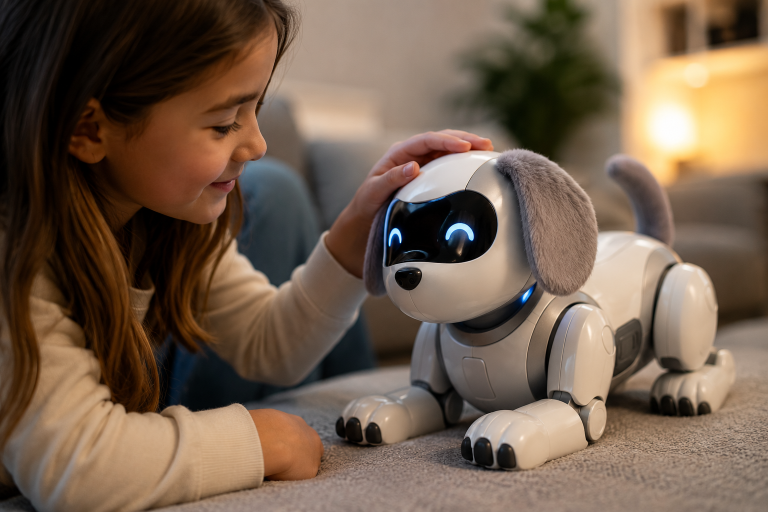
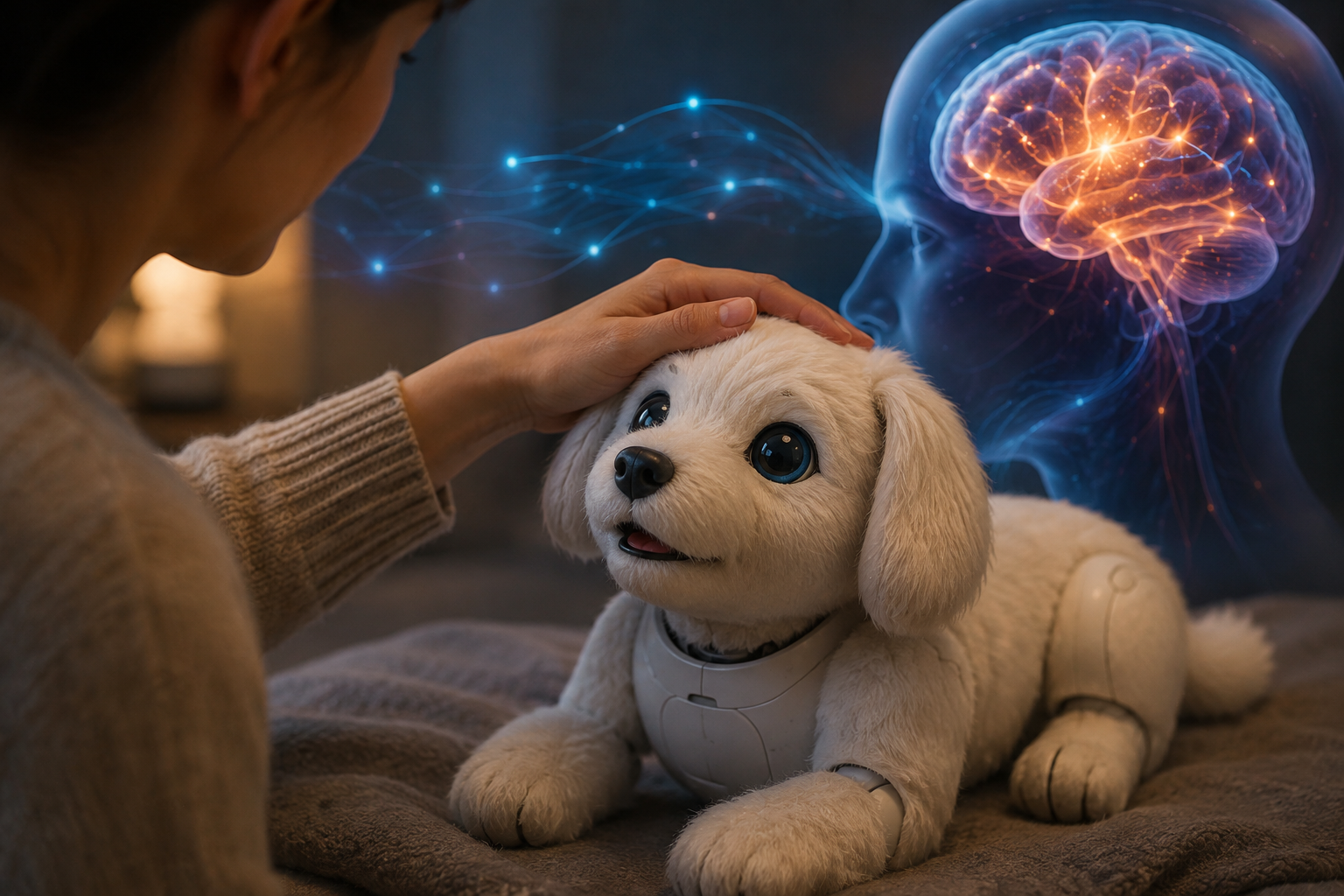
A person strokes the soft fur of a robotic pet. The robot turns its head, makes a sound, moves toward the person’s hand, or appears to relax. The user knows the animal isn’t alive, yet the interaction can still produce measurable emotional, behavioral, physiological, and neural responses. That apparent contradiction is one of the most interesting questions in neuroscience and haptic interactions.
Touch isn’t simply information about pressure against the skin. The brain interprets tactile sensations alongside visual cues, expectations, memories, emotional context, and the perceived intentions of whoever or whatever is producing the interaction. When a robot pet responds to touch in a believable way, the brain may process the encounter as more than contact with an ordinary object.
Research involving social robots, including therapeutic robot pets such as PARO, suggests that tactile interaction can influence pain perception, mood, physiological arousal, sensorimotor brain activity, and social engagement. Understanding these responses could help engineers create better companion robots while giving neuroscientists another way to study how touch, emotion, perception, and social cognition interact.
How the Brain Processes Touch From Robot Pets
Touch begins as a physical event, but the brain rapidly transforms it into something much richer.
Specialized sensory receptors in the skin detect pressure, vibration, stretching, temperature, and other mechanical or thermal changes. Signals travel through peripheral nerves toward the spinal cord and brain, where multiple regions participate in determining what happened, where it happened, and what the experience means.
Sensory and Affective Touch Follow Different Neural Processes
Some tactile pathways help the brain identify practical details such as the location and intensity of contact. Others contribute more strongly to the emotional quality of touch.
Gentle stroking, for example, can engage specialized unmyelinated nerve fibers known as C-tactile, or CT, afferents. Research on affective touch has connected this type of stimulation with activity involving the insular cortex and other areas associated with emotional and bodily processing. The broader neural circuitry involved in touch can include the insula, orbitofrontal cortex, anterior cingulate cortex, and sensorimotor regions.
This helps explain why two physically similar touches don’t necessarily produce identical experiences. A reassuring stroke from someone you trust may feel pleasant. Unexpected contact from a stranger could cause alertness. A vibration from a smartphone carries a completely different meaning even though it also stimulates tactile receptors. The nervous system therefore doesn’t interpret touch independently from context.
Bottom-Up Sensation Meets Top-Down Interpretation
A useful way to understand robot-pet interactions is to separate bottom-up and top-down processing. Bottom-up processing begins with sensory information entering the nervous system. The softness of artificial fur, vibration from a motor, pressure against the hand, warmth from the robot’s surface, and its movement all generate sensory signals.
Top-down processing involves what the brain already knows or expects. Does the user believe the robot is friendly? Have they been told it can recognize touch? Does it resemble an animal they love? Do they expect it to respond? Have repeated interactions taught them that stroking its head produces a positive reaction?
These expectations can shape how incoming sensations are interpreted. A small vibration inside a plastic device might simply feel mechanical. Put the same rhythmic sensation inside a furry robot shaped like an animal and describe it as a heartbeat, and the experience acquires another layer of meaning.
Effective robot-pet design therefore depends on more than technically accurate haptic feedback. Sensation, appearance, behavior, timing, and context need to support the same interpretation.
How Haptic Interaction Makes Robot Pets Feel Responsive
Haptics broadly refers to technologies and interactions involving the sense of touch. In robot pets, haptic interaction can work in both directions. The user touches the robot, and sensors detect what happened. The robot then generates a response through movement, vibration, sound, posture, warmth, or another form of feedback.
Touch Creates a Continuous Human-Robot Feedback Loop
Consider what happens when someone pets a sophisticated robotic animal. Pressure sensors underneath its artificial fur may detect the location, force, or duration of the stroke. Software interprets those signals and selects a response. Motors might turn the robot’s head toward the user’s hand, while speakers generate an animal-like vocalization.
The user sees, hears, and potentially feels that response. The interaction follows a recurring sequence: human action, robot sensing, robot response, human perception, and another human action.
The loop is neurologically significant because the brain is highly sensitive to contingency. If touching something repeatedly causes an immediate, meaningful response, the object begins behaving less like a passive object and more like an interactive agent.
Timing and Reciprocity Shape the Experience
Timing matters enormously. If a robot responds several seconds after being stroked, users may not associate its behavior with their action. If the response occurs naturally and predictably, the relationship between action and consequence becomes easier for the brain to recognize.
Touch becomes particularly meaningful when it feels reciprocal. Petting a stuffed animal produces tactile stimulation, but the stuffed animal doesn’t respond. A robot pet can.
PARO, for example, is a therapeutic robot modeled after a baby harp seal. Its design incorporates tactile sensors, microphones, actuators, and behaviors that allow it to react when people interact with it. It can move its body, respond to petting, produce sounds, and engage users visually. Those reactions provide evidence that the user’s actions have been detected.
Over repeated interactions, users may begin anticipating the robot’s reactions. They might stroke its head because they expect a particular movement, speak because they expect a vocal response, or reposition it because they anticipate how it will react. That prediction-response cycle can help transform isolated tactile sensations into an ongoing interaction.
What Happens in the Brain During Human-Robot Touch
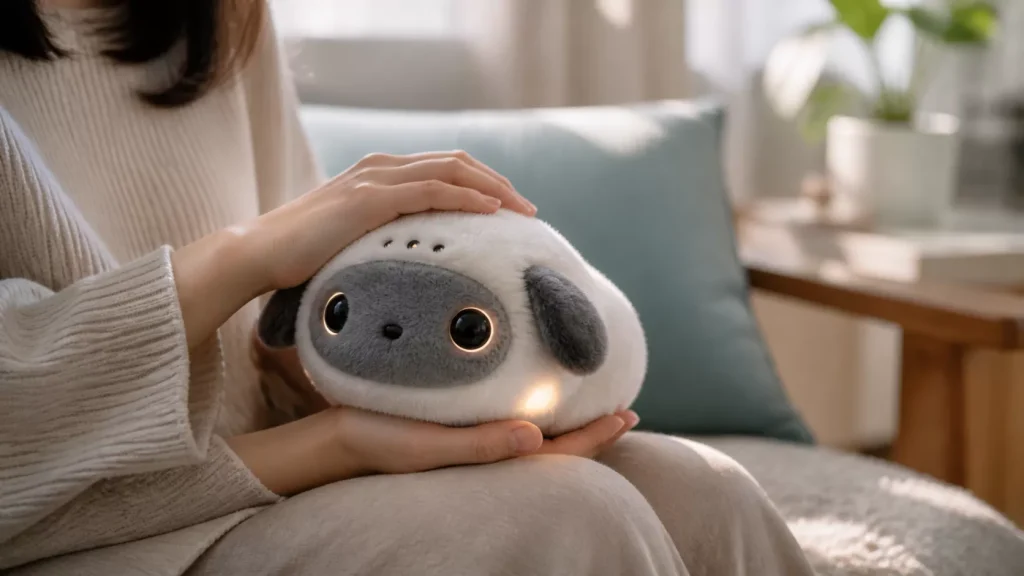
Humans readily attribute intentions and emotions to nonhuman things. People talk to virtual assistants, apologize after bumping into robots, give names to cars, and describe computers as stubborn when software behaves unexpectedly. Robot pets can intensify this tendency because they combine physical embodiment with behaviors associated with living animals.
Movement can imply intention. Eye orientation can imply attention. Vocalizations can suggest emotion. Touch responsiveness can create reciprocity. The brain can therefore receive several signals simultaneously suggesting that an object is socially relevant.
Robot Interaction Can Engage Social Processing Systems
Neuroscience research supports the idea that interactions with robots can recruit systems associated with social and cognitive processing, although responses aren’t necessarily identical to human-human interaction.
Functional imaging research comparing conversations with humans and robots, for example, has found both overlapping and differing patterns of neural engagement across networks involved in language, person perception, and cognition.
Robot pets add tactile information to this equation. Instead of merely watching or speaking to an artificial agent, users physically interact with something that appears to react to their behavior. That additional sensory channel may substantially change how the interaction is interpreted.
Sensorimotor Brain Activity Changes During Human-Robot Touch
Electroencephalography, commonly known as EEG, provides one way researchers can examine what happens in the brain during tactile human-robot interaction.
One study investigated sensorimotor oscillations while adults participated in a reciprocal touch task involving either another human or a robot. Participants sent and received tactile stimulation while researchers examined changes in EEG rhythms associated with sensorimotor processing. The researchers found differences depending on whether participants believed they were interacting with a human or a robot.
For example, activity involving the sensorimotor mu rhythm differed when participants anticipated stimulation from a human compared with a control condition in which nobody received stimulation. The corresponding effect was less pronounced when participants anticipated stimulation involving the robot.
Differences were also observed in beta rhythm activity after participants initiated tactile stimulation. These findings illustrate an important principle in neuroscience and haptic interactions: identical or similar physical sensations can produce different neural responses depending on who the brain believes is involved. Expectation and social interpretation can influence neural activity.
How Robot Pets May Affect Emotion, Stress, and Pain
The effects of robot-pet interaction aren’t limited to sensory processing. Researchers are also investigating whether responsive robotic companions can influence emotional states, physiological arousal, and pain.
Robot Touch May Influence Pain Perception
One of the more intriguing findings from robot-pet research involves pain.
A study involving 83 healthy young adults examined whether interacting with PARO influenced experimentally induced pain, mood, and salivary oxytocin. Participants who interacted with the robot reported decreased pain and increased happiness compared with baseline. Touching PARO produced a larger reduction in pain ratings than having the robot present without touching it. The result suggests that physical interaction itself contributed something beyond simply seeing the robot.
Interestingly, the effect also related to how participants perceived the interaction. People who felt more capable of communicating with PARO experienced a greater reduction in pain. That relationship highlights the interaction between sensory and cognitive processing.
A robotic companion that feels socially responsive could capture attention, alter emotional state, provide pleasant tactile stimulation, or change expectations surrounding an uncomfortable experience. Several of these processes could potentially contribute to changes in perceived pain.
That doesn’t make robot pets a replacement for medical pain treatment. It does make haptic robots an interesting subject for research into nonpharmacological influences on pain perception.
Haptic Interaction May Help Regulate Arousal
One hypothesis in affective neuroscience is that appropriate touch can function as a safety signal. When the nervous system detects potential danger, neural and physiological mechanisms prepare the body to respond. Under safe conditions, sensory and contextual information can contribute to reducing that defensive state.
Research on calming touch has proposed pathways involving areas such as the insular cortex and amygdala, along with broader systems involved in stress, reward, and autonomic regulation.
Robot pets could potentially provide several compatible safety cues simultaneously. Their fur may feel pleasant. Their movements may be slow rather than threatening. Their sounds may be soft. Their reactions can be predictable. The user also controls when and how the interaction occurs.
Predictability is especially relevant. An unpredictable machine touching someone can create alertness rather than relaxation. Research involving tactile interaction with the humanoid Pepper robot found physiological differences between touching the robot and being touched by it, with robot-initiated contact associated with signs interpreted as greater alertness or arousal.
Designing calming haptic interaction therefore isn’t simply a matter of adding touch. Designers must consider who initiates it, where contact occurs, how quickly the robot moves, and whether the user expects the interaction.
Oxytocin Doesn’t Provide a Simple Measure of Robot Bonding
Discussions about pets, social touch, and human bonding frequently mention oxytocin. The hormone is often described simply as a “bonding hormone,” but that label can create misleading expectations about human-robot interaction.
The PARO pain study produced a particularly interesting result. Despite improvements in happiness and reductions in reported pain, participants experienced decreased rather than increased salivary oxytocin levels.
Other human-robot research further complicates the picture. Studies combining neural measurements with salivary oxytocin, behavioral measures, and self-reported trust indicate that relationships among robot behavior, trust, neural responses, and oxytocin can depend heavily on context. This matters because neurobiology rarely works through a single chemical acting as an emotional switch.
Robot-pet experiences emerge from interacting sensory, cognitive, emotional, hormonal, and autonomic processes. Researchers therefore need to examine multiple signals rather than treating one biomarker as proof that someone has bonded with a robot.
Why Robot Pet Design Changes Brain and Behavioral Responses
The physical and behavioral characteristics of a robot determine what sensory information reaches the user and how easily the brain can interpret that information.
Texture, Pressure, Warmth, and Movement Shape Haptic Perception
Texture is one obvious factor. Soft fur produces very different tactile input from rigid plastic. But other variables can be equally important. Pressure affects whether contact feels gentle or intrusive. Movement speed influences predictability and perceived intention. Temperature can make a surface feel more biologically plausible. Vibration can simulate breathing, purring, or heartbeat-like rhythms.
The best haptic design isn’t necessarily the most realistic one. A perfectly realistic robotic dog that occasionally moves in unnatural ways could produce a more unsettling experience than a stylized robot whose behavior remains consistent. The brain constantly generates predictions about sensory events, and unexpected mismatches can attract attention. This creates a haptic version of the broader uncanny-valley problem.
As robots become more animal-like, users may develop stronger expectations about how they should move and feel. Small inconsistencies can consequently become more noticeable. Successful robot pets need sensory coherence rather than realism at any cost.
Predictability and Surprise Need to Be Balanced
Brains are prediction systems. During repeated interactions, people learn relationships between actions and outcomes. If stroking a robot pet causes it to close its eyes and make a soft sound, users quickly learn the pattern.
Some predictability helps establish agency and trust. Too much predictability, however, can make a robot feel mechanical.
Imagine a robot pet that performs exactly the same three-second response every time its head is touched. The user can quickly recognize the programmed sequence. The interaction loses some of its apparent spontaneity.
Designers therefore face an unusual challenge: behavior needs to be predictable enough to feel coherent but variable enough to remain engaging. Small variations in gaze, vocalization, movement, timing, or posture may make the robot seem more autonomous without destroying the user’s ability to understand cause and effect.
Reliability remains crucial. Research into social human-robot interaction suggests that robot errors can reduce trust, particularly when users have developed high expectations for the robot’s social capabilities. The more lifelike the interaction becomes, the more noticeable inappropriate responses may be.
Haptic Sensors Can Help Robots Interpret Human Behavior
Touch isn’t only an output channel. It’s also valuable data. People touch animals differently depending on their emotional state and intentions. A person might stroke gently when relaxed, squeeze when seeking comfort, tap playfully, or suddenly pull away. Pressure sensors, accelerometers, capacitive sensors, and other technologies can allow robot pets to capture aspects of these behaviors.
Research using furry robotic platforms has demonstrated that patterns of human touch can contain information related to emotional expression. Machine-learning systems can potentially classify forms of affective touch based on sensor data collected during physical interaction. This creates the possibility of adaptive haptic interaction.
Instead of responding identically every time someone touches it, a future robot pet might distinguish between slow stroking, playful tapping, holding, or abrupt contact. Its behavior could then change accordingly. The resulting interaction would create a more sophisticated feedback loop in which the robot doesn’t simply detect contact. It attempts to interpret how the person is touching it.
Social Cognition, Empathy, and Emotional Attachment to Robot Pets
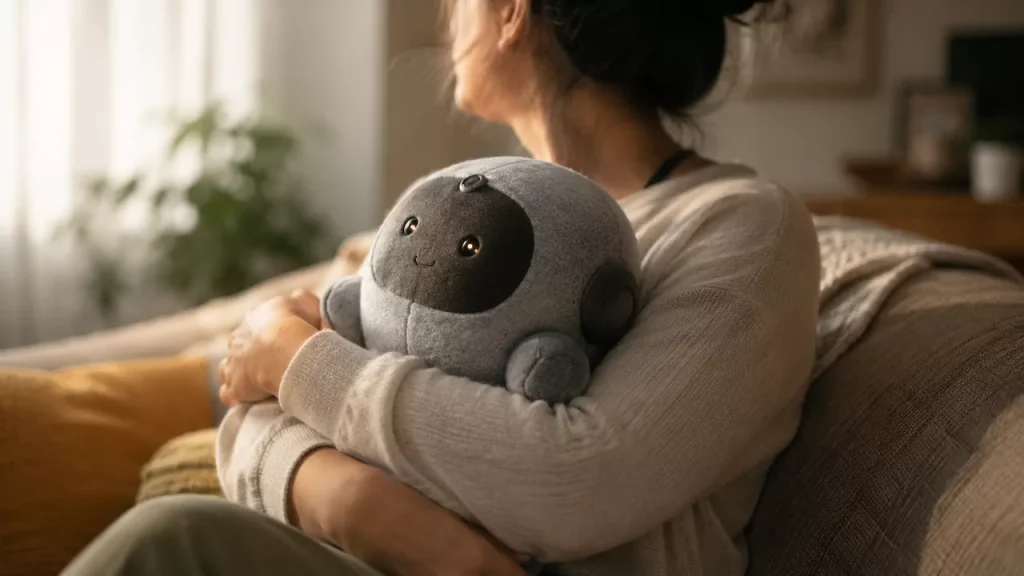
Physical responsiveness can encourage people to interpret a robot as a social agent rather than an ordinary device. That doesn’t necessarily mean users believe the robot has genuine feelings. Humans can respond socially to artificial agents while remaining fully aware that their behavior is programmed.
People Can Show Empathic Responses Toward Robots
People don’t necessarily need to believe that robots truly experience emotions before responding empathetically toward them.
Neuroscience studies examining painful and neutral situations involving humans and robots suggest that some neural processes associated with socially meaningful information can become engaged when artificial agents appear to experience pain or distress.
Individual differences matter considerably. People with higher levels of empathy, greater familiarity with robots, or stronger tendencies to anthropomorphize technology may respond differently from people who see robots primarily as machines.
Robot pets may be particularly suited to encouraging emotional interpretation because people already have familiar behavioral templates for interacting with animals.
A robotic seal doesn’t need to hold a conversation. Turning toward touch, producing a pleasant vocalization, or appearing to enjoy being stroked may be enough to encourage social engagement.
Emotional Responses Don’t Mean the Brain Thinks the Robot Is Alive
Claims that robot pets “trick the brain” can oversimplify what neuroscience actually suggests. The brain can respond emotionally to fictional characters, photographs, music, virtual environments, and imagined situations without confusing them with physical reality.
Robot pets may operate through a similar principle. Users can simultaneously understand that a robot isn’t alive while responding emotionally to its movements, sounds, tactile properties, and apparent attention.
That distinction is crucial when interpreting neuroscience research. Neural engagement doesn’t prove that users mistake robots for animals. It shows that artificial stimuli can activate systems involved in meaningful perception and social behavior.
How Robot Pets Compare With Real Animals
The fact that robot pets can produce measurable neural and physiological responses doesn’t mean they duplicate interaction with living animals.
Real animals provide extraordinarily complex multisensory experiences. Their breathing changes. Muscles shift underneath their skin. Body temperature varies. They smell differently. Their gaze and movement are highly dynamic. They initiate unexpected behavior and continuously adapt to their environment.
Robots approximate only selected elements of this complexity.
Real Animals Provide Richer Multisensory Feedback
Living animals continuously produce sensory information that robotic systems struggle to reproduce.
A dog’s body changes subtly as it breathes. Its skin and fur shift with movement. Muscle tension changes depending on posture and emotion. Its heartbeat, body temperature, scent, vocalizations, and spontaneous movements create an enormous amount of sensory variation.
Robot pets can recreate selected cues such as warmth, vibration, movement, fur, and vocalizations, but these cues are typically more constrained.
That doesn’t necessarily make robot interaction ineffective. Instead, it raises a more useful research question: which parts of animal interaction are actually responsible for particular human responses?
Comparing Robots and Animals Can Reveal Which Cues Matter Most
Neuroscience research can compare real animals, robotic companions, and noninteractive objects while measuring brain activity and behavior. These comparisons may help researchers determine whether fur alone changes tactile processing, whether responsive movement substantially increases engagement, or whether knowing an animal is alive produces different neural responses even when other sensory characteristics are similar.
Robot pets offer an experimental advantage because researchers can manipulate individual features independently. A robotic companion can be programmed to move with or without touch, produce or withhold sounds, change response latency, alter vibration patterns, or maintain different surface temperatures. That level of control is much harder to achieve with a living animal.
Robot Pets as Tools for Neuroscience and Therapy Research
Robot pets aren’t only potential therapeutic technologies. They can also function as experimental platforms.
Studying human-human or human-animal interaction creates many variables researchers can’t fully control. A dog may behave differently between participants. A human partner may unconsciously change facial expressions, timing, pressure, or posture.
Robots can reproduce carefully programmed behavior.
Robots Allow Researchers to Isolate Individual Haptic Variables
Researchers can systematically change stroke response latency, movement speed, surface temperature, simulated breathing, vocalization, eye contact, or tactile feedback while measuring EEG, functional near-infrared spectroscopy, skin conductance, heart rate variability, behavior, and subjective experience. That creates opportunities to investigate specific questions about social touch.
For example, researchers could determine whether a robot must respond immediately for touch to feel reciprocal, whether warming artificial fur changes perceived emotional connection, or whether simulated breathing affects relaxation. Instead of merely asking whether robot pets work, neuroscience can investigate exactly which features produce particular responses.
Therapeutic Applications Require More Evidence
Positive findings involving pain, mood, engagement, or stress shouldn’t automatically be interpreted as proof that robot pets provide a clinically effective treatment. Laboratory studies may involve small samples, short interactions, healthy participants, or tightly controlled conditions that don’t reproduce long-term use.
Therapeutic outcomes also depend on the population and setting. A robotic companion used in elder care raises different questions from a robot designed for children, rehabilitation patients, people experiencing social isolation, or healthy adults seeking companionship. Future research needs to examine durability of effects, individual differences, appropriate comparison groups, long-term engagement, and whether benefits continue after novelty wears off.
Personalized Haptic Interaction Could Shape the Next Generation of Robot Pets
People don’t respond to robots in identical ways. Previous experiences with technology, attitudes toward robots, sensory preferences, cultural expectations, age, familiarity with animals, and individual differences in empathy can all influence an interaction. The same haptic behavior may comfort one person and irritate another.
Robot Pets Could Learn Individual Touch Preferences
Someone who dislikes unexpected touch may prefer a robot that only responds after being touched. Another user might enjoy a companion that occasionally initiates contact.
Future robot pets could potentially learn these preferences. A system might determine that one user responds positively to slow movement and quiet vocalizations while another engages more strongly with active behavior.
Machine learning could also help robots associate particular patterns of touch with subsequent user reactions. Over time, the system could adjust how frequently it moves, vocalizes, vibrates, approaches, or initiates interaction.
More Stimulation Isn’t Always Better
Personalization should also include the ability to reduce stimulation. Constant movement, sound, vibration, or unsolicited contact could create sensory overload rather than comfort. A user may enjoy tactile feedback but dislike frequent vocalizations, or appreciate warmth while finding vibration distracting.
This has practical implications for accessible robot design. Rather than maximizing the number of interactive features, designers can give users greater control over intensity, frequency, predictability, and sensory modality. The goal should be responsive interaction that respects the user’s behavioral and sensory signals.
How Neuroscience Could Improve Future Haptic Robot Pets
Advances in flexible tactile sensors, artificial skin, soft robotics, machine learning, and compact actuators are expanding what robot pets can physically perceive and express.
The next major improvement may not come from making robots look dramatically more realistic. It may come from making their sensory behavior more neurologically coherent.
Closed-Loop Haptics Could Make Interaction More Natural
A sophisticated companion robot could detect how it’s being touched, interpret patterns in that contact, combine tactile information with voice and movement, and choose an appropriate response. It could then adjust future behavior based on how the user reacts. That would turn haptic interaction into a continuous closed loop rather than a collection of predefined reactions.
For example, the robot might detect prolonged gentle stroking, respond with slower movement and subtle vibration, observe that the user continues the interaction, and gradually learn that this combination encourages engagement. The interaction becomes adaptive rather than simply reactive.
Neuroscience Can Identify Which Features Actually Matter
More lifelike technology isn’t automatically better technology. Neuroscience can help engineers identify which sensory and behavioral features meaningfully affect attention, emotional processing, arousal, trust, and social engagement.
A subtle change in response timing might matter more than highly realistic fur. Predictable movement might have a stronger calming effect than complex facial expressions. User-controlled touch could produce a different physiological response from robot-initiated contact.
Identifying those relationships could allow developers to prioritize features based on measurable human responses rather than assumptions about realism.
What Brain Responses Tell Us About Human-Robot Interaction
Neuroscience and haptic interactions reveal that touching a robot pet is far more complex than placing a hand against a machine.
The nervous system processes texture, pressure, movement, timing, temperature, and other physical signals while the brain simultaneously evaluates context, expectations, predictability, emotional meaning, and apparent agency. When those elements align, a robot pet can become a socially meaningful stimulus rather than merely an electronic object.
Research has connected human-robot touch with changes in sensorimotor neural activity, physiological arousal, mood, pain perception, and social interpretation. At the same time, findings involving oxytocin, empathy, trust, and differences between human, animal, and robotic interaction show why simple claims about robots tricking the brain should be avoided.
The more useful question is how the brain combines artificial touch with meaningful feedback. Answering that question could improve companion robots, therapeutic devices, assistive technologies, and other forms of social robotics. It could also teach researchers something broader about the human brain itself: meaningful touch doesn’t depend only on what touches us. It depends on what our brains believe the interaction means.