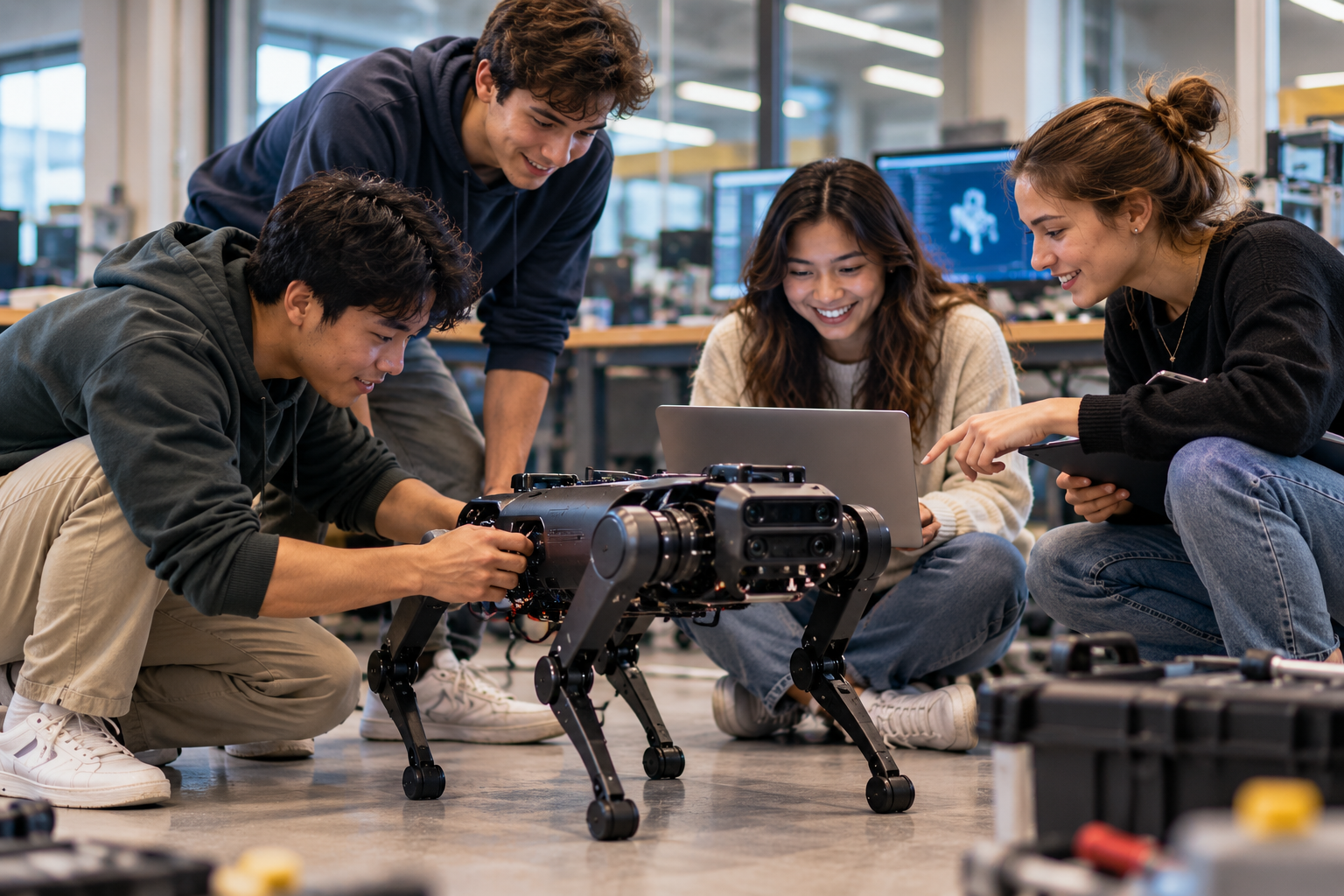
Case Studies: Success Stories of Robot Pets in Schools and Institutes
Table of Contents
Robot pets have traditionally been associated with entertainment or companionship, but educators and researchers are finding more ambitious uses for them. From robotic dogs that students build and program to animal-like social robots used as classroom companions, these machines are creating new ways for students to interact with technology.
The most useful success stories of robot pets in schools and institutes aren’t simply cases where students enjoyed having a robot around. They show how physical robots can support specific educational goals, including programming, engineering, problem-solving, personalized learning, and research.
Research into educational robotics is also becoming more substantial. A 2026 meta-analysis covering 58 studies and 5,806 participants found moderate-to-large overall effects of educational robotics on learning outcomes. However, results depend considerably on how robots are incorporated into instruction, making individual case studies particularly valuable for understanding what actually works.
Why Robot Pets Can Work as Educational Tools
A robot pet occupies an unusual position between a conventional computer and a social participant.
Students don’t simply look at information on a screen. They can watch a robot move, respond to its behavior, program it, troubleshoot it, or interact with it as though it were another participant in an activity.
That physical presence is known as embodiment. In educational settings, embodiment can turn abstract concepts such as algorithms, sensors, movement, artificial intelligence, and feedback loops into something students can observe directly.
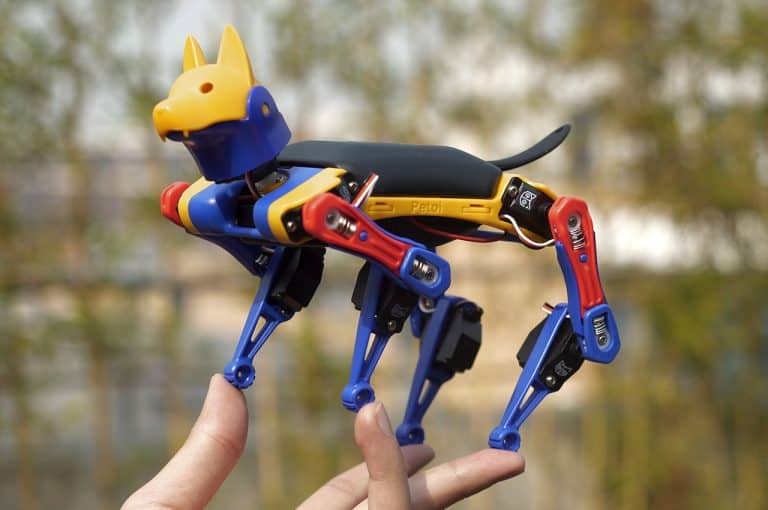
Animal-like designs can also make sophisticated technology feel approachable. A quadruped robot, for example, provides a practical platform for studying programming, mechanics, electronics, control systems, and AI while giving students an immediately understandable objective: make the robot stand, walk, balance, navigate, or respond.
The educational benefit, however, doesn’t come from the robot’s appearance alone. Successful deployments tend to connect the robot to a defined learning activity rather than treating it as classroom entertainment.
Case Study 1: Personalized Robot Learning Companions in Primary School
One particularly useful classroom experiment examined what happened when autonomous robots became learning companions for primary school students over an extended period.
Researchers placed two autonomous robots in two matched primary school classrooms for two continuous weeks. Importantly, the robots weren’t demonstrated once and removed. They remained embedded in the normal learning environment and operated without researchers constantly supervising their interactions.
The experiment compared a robot that personalized its social behavior with one that didn’t. Children interacting with both versions demonstrated learning, but students working with the personalized robot showed greater learning for a novel subject. Researchers also found indications that the improvement extended to other classroom performance.
The personalized robot also received greater acceptance from students. This distinction matters for schools considering robot pets as educational companions.
Simply placing an interactive robot in front of students doesn’t automatically improve learning. The robot becomes more educationally meaningful when its behavior responds to the learner. Remembering information, adjusting activities, providing appropriate feedback, or changing interactions according to previous performance can make the experience more relevant.
Personalization shouldn’t be confused with replacing teachers. Instead, a robot can provide another interaction point within a lesson. A teacher might introduce a concept to the entire class, while students subsequently work through an activity with a robot that responds differently depending on their progress.
That approach also illustrates a potentially valuable role for future AI-powered robot pets. Rather than functioning as miniature robotic teachers, they could operate as interactive learning partners within teacher-designed lessons.
Case Study 2: AIBO in Early Childhood Education
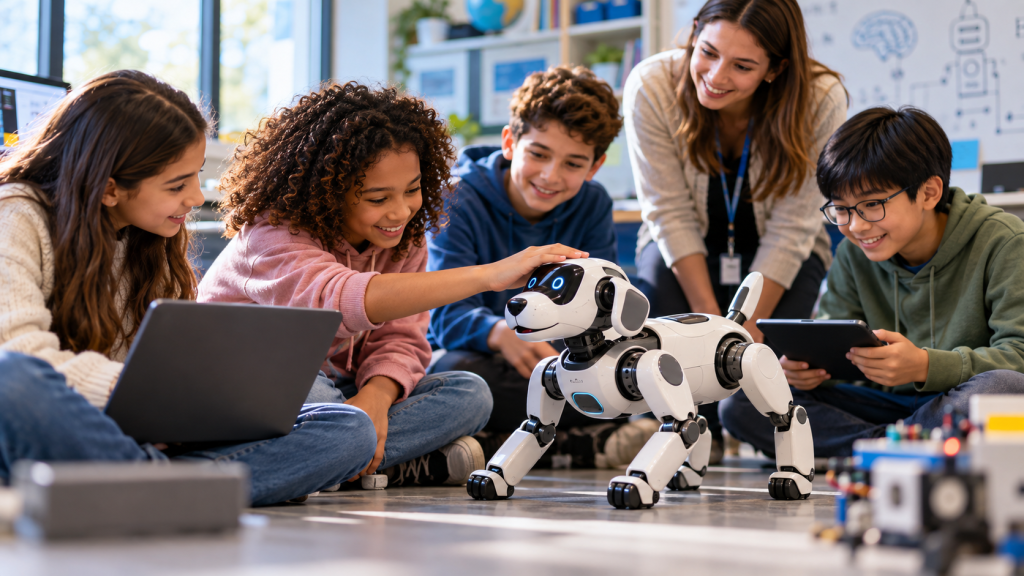
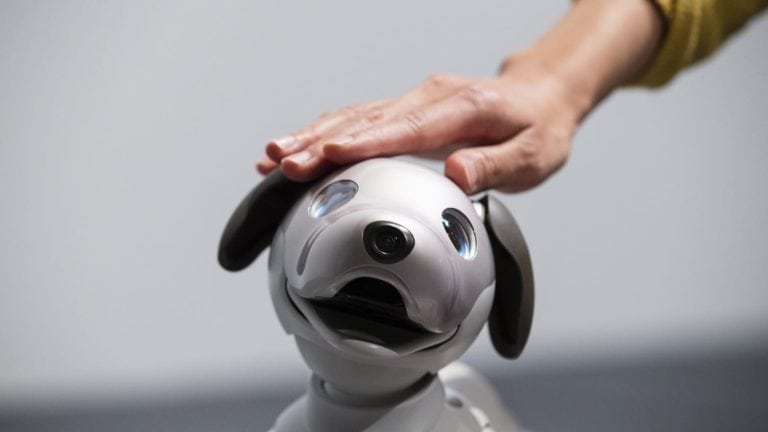
One of the earlier examples of a robotic pet entering an educational environment involved Sony’s AIBO robot dog.
Researchers introduced an AIBO ERS-311B into kindergarten classroom activities involving children ages four to six. The project investigated whether a robotic pet could work as an interactive interface within an early childhood multimedia education system.
Researchers examined children’s interest and concentration, including their responses to questions involving the robot. Most children demonstrated considerable interest in AIBO. That finding highlighted an advantage that continues to make robot pets interesting to educators: physical interaction can change how children experience digital information.
A lesson displayed on a conventional screen remains visually separated from the learner. A robotic animal can move through the same physical environment as the child and generate responses that feel connected to the child’s actions.
For younger students especially, this can create opportunities to build activities around observation, communication, prediction, and cause and effect.
The experiment also identified practical problems with bringing robots into kindergarten classrooms, however. This is an important part of the case study rather than a failure of it. Successful educational technology requires teachers to understand both what captures students’ attention and what remains practical during everyday classroom use.
Case Study 3: Robotic Dogs for Animal Welfare Education
An unusual application of robot pets has emerged in animal welfare education.
Researchers have explored whether robotic pets can help children learn how to understand and interact appropriately with real animals. One recent project involved children between eight and 12 years old alongside animal welfare educators in the development of educational robotic pet concepts.
Instead of assuming what children or educators needed from the technology, researchers incorporated both groups into the design process.
The project examined scenarios involving pet mammals and considered how interactive narratives and zoomorphic robots could support animal welfare education.
A related classroom study, “Pawsitive Patch,” used a robotic dog in children’s animal welfare education. The research was conducted during regular school hours in children’s normal classrooms, providing a more realistic educational environment than a laboratory-only demonstration.
The concept demonstrates something particularly useful about robot pets: they can simulate interactions that might otherwise be difficult to reproduce repeatedly in a classroom.
Teachers can’t always bring a live dog into school. Allergies, fear of animals, animal welfare concerns, unpredictable behavior, and logistical restrictions can make live-animal demonstrations complicated.
A robotic dog doesn’t recreate every aspect of interacting with a living animal, nor should it be presented as equivalent to one. It can, however, provide a controlled platform for discussing behavior and practicing scenarios before students encounter real animals.
Case Study 4: Stanford Students Build Their Own AI Robot Dogs
At the university level, the educational role of robot pets changes considerably. Instead of interacting with a finished robotic companion, students can build the robot themselves.
At Stanford University, students in an introductory robotics course have worked with Pupper, an AI-powered quadruped robot. The platform evolved from Stanford Doggo, originally developed by the Stanford Student Robotics club.
Building a quadruped robot forces students to combine multiple areas of engineering and computer science.
A legged robot must coordinate motors and joints while maintaining stability. Students therefore have to move beyond writing code that produces an answer on a screen. Their algorithms create visible physical consequences.
If something is wrong, the robot might stumble, move inefficiently, or fail to perform the intended behavior. This makes debugging tangible.
Students progressively develop the knowledge needed to address increasingly sophisticated robotics and AI problems. Stanford’s program demonstrates how the approachable concept of a robot dog can become a platform for advanced technical education.
The educational value isn’t necessarily the finished robot. It’s the collection of engineering problems students must solve to make it work.
Case Study 5: Botzo at IE University
Students at IE University similarly turned the robot-dog concept into a practical engineering project.
Computer Science and Artificial Intelligence students Vera, Gregorio, and Rodrigo developed Botzo, the university’s first robot dog, using resources available through the IE Robotics & AI Lab.
Botzo uses a two-degree-of-freedom system built around Arduino technology. Students incorporated inverse kinematics to produce increasingly realistic movement.
One of the motivations behind Botzo was to make robotics knowledge more accessible. That objective addresses an important challenge in robotics education. Students can learn programming, mathematics, and engineering concepts separately for years without seeing how those disciplines interact inside a functioning machine.
Building a robot pet forces those disciplines together. Mechanical design affects movement. Programming determines behavior. Mathematics helps calculate joint positions. Electronics connect software instructions to physical components.
The robot therefore becomes a shared engineering problem rather than a project belonging exclusively to one discipline.
Case Study 6: Austin Peay State University’s Quadruped Robot
Austin Peay State University introduced a robotic dog to support students in Engineering Technology and Computer Science and Information Technology.
The university acquired the quadruped specifically because its capabilities could serve multiple scientific and technical disciplines. Students can work with programming languages including Python and C++, giving them opportunities to apply coding skills to a physical robotic platform.
This example illustrates why robot dogs can be especially useful investments for higher education institutions. A specialized laboratory device might support one course or research area. A programmable quadruped can potentially connect computer science, AI, electronics, mechanical systems, sensing, and engineering technology.
That creates opportunities for collaboration between departments. Instead of teaching programming as an isolated activity, instructors can give students a physical problem to solve. Code can control movement, interpret sensor information, or eventually support increasingly autonomous behaviors.
This multidisciplinary potential is one of the strongest arguments for robot pets in colleges and technical institutes.
Case Study 7: Scout Brings AI Research Into the Physical World
The University of Minnesota School of Statistics introduced another robotic dog, Scout, as a platform for AI research and student training.
The motivation behind Scout highlights a problem familiar to AI researchers: an algorithm that performs well in a simulation doesn’t necessarily behave the same way in the physical world. Researchers wanted a platform that would allow AI methods to encounter uncertainty, changing environments, and real physical interactions. This makes Scout especially interesting as an educational case study.
Students studying artificial intelligence frequently work with datasets, software environments, and simulations. Those tools are valuable, but physical robots introduce complications that simulated environments may simplify.
Sensors produce imperfect information. Surfaces differ. Obstacles appear. Mechanical systems have physical limitations. A robotic dog creates a bridge between theoretical AI and embodied AI, where an intelligent system has to perceive and act within the physical environment.
That experience can help students understand why deploying an algorithm in the real world requires more than achieving good results in a controlled simulation.
What These Robot Pet Success Stories Have in Common
These examples involve very different students and educational objectives. A kindergarten interacting with AIBO has little in common academically with university students programming quadruped robots.
Yet several patterns emerge. The strongest applications give the robot a specific educational function. It might serve as a personalized learning companion, demonstrate animal-related scenarios, provide an engineering challenge, or create a physical platform for AI experimentation.
Successful programs also tend to emphasize interaction rather than observation. Students aren’t simply watching someone demonstrate an impressive robot. They’re communicating with it, programming it, building it, testing it, or solving problems through it.
That distinction separates educational robotics from technology demonstrations.
What Research Says About Robots in Real Classrooms
Individual case studies are encouraging, but they shouldn’t be interpreted as proof that putting a robot pet in every classroom will improve academic performance.
A review of 23 field-based studies involving social robots in classrooms found that robots could be deployed successfully in natural educational settings. At the same time, researchers identified significant challenges with long-term deployments, autonomous interactions, personalization, and ethical and safety considerations. The evidence didn’t establish that social robots outperform human teachers or other educational technologies.
A newer review of social robots in primary schools similarly found that much of the research has concentrated on curriculum-based academic learning, including mathematics and second-language learning. Thirty peer-reviewed studies were included, while direct research into social-emotional learning remained comparatively limited.
Evidence from educational robotics more broadly is promising. The 2026 meta-analysis of 58 studies reported positive effects on cognitive and affective learning outcomes. However, a separate systematic review of robotics in after-school and extended-education programs cautioned that stronger effects often came from less rigorous study designs, while controlled estimates tended to be smaller or more mixed.
The takeaway isn’t that robots do or don’t work. It’s that implementation matters.
Where Robot Pets Fit Best in Education
The case studies suggest that robot pets are most useful when their physical and interactive characteristics solve a genuine educational problem.
In elementary classrooms, that might mean creating an engaging learning companion or providing a controlled way to practice interactions. In middle and high school, a programmable robotic pet can make coding, engineering, sensors, and AI more concrete. At universities and technical institutes, quadruped robots can become sophisticated research platforms.
Schools therefore shouldn’t begin by asking, “How can we use a robot dog?” A better starting point is identifying the learning objective and determining whether physical robotics offers something that conventional software, tablets, or other classroom tools can’t provide.
For example, students learning basic programming may not need an expensive quadruped. Students studying locomotion, embedded systems, computer vision, or autonomous navigation may gain considerably more from having a physical robot that exposes them to real-world constraints.
Teachers Still Determine the Educational Value
Robot pets don’t remove teachers from the learning process. If anything, the case studies show how much instructional design determines whether the technology becomes meaningful.
Teachers decide what students should learn, how interaction with the robot fits into the lesson, what students should observe, and how performance should be evaluated. The robot supplies capabilities that teachers can build around.
A robot pet might intentionally make mistakes, so students have to identify them. It might respond differently according to a student’s previous answers. Older students might modify its code and immediately observe how their changes affect its physical behavior.
Without that instructional structure, even an advanced robot can quickly become an expensive classroom novelty.
Measuring Whether a Robot Pet Program Actually Works
Schools adopting robot pets should define success before deployment rather than relying on student enthusiasm afterward. Engagement is valuable, but it isn’t synonymous with learning.
A class may be fascinated by a robot without understanding the material any better. Schools should therefore measure outcomes connected to the original objective. A programming activity might evaluate students’ ability to debug code or explain sensor behavior. A personalized learning application could compare knowledge before and after repeated sessions.
Educators should also watch for the novelty effect. Students may initially participate more enthusiastically simply because they’ve never encountered a robotic dog before. Longer deployments can reveal whether engagement persists once the robot becomes familiar.
This is one reason long-term classroom research remains particularly valuable.
What the Next Generation of Educational Robot Pets Could Look Like
The next stage of robot pets in education will likely combine increasingly capable AI with cheaper and more accessible robotics hardware.
That could make personalization more sophisticated. Instead of repeating predetermined behaviors, future systems may adjust explanations, recognize patterns in student performance, maintain context across sessions, and respond more naturally to spoken instructions.
Universities may push in another direction, using quadruped platforms to teach embodied AI, reinforcement learning, computer vision, autonomous navigation, and human-robot interaction.
Meanwhile, simpler robotic animals could remain valuable in younger classrooms precisely because they don’t need to be extraordinarily intelligent. Predictable behaviors can sometimes be easier for teachers to incorporate into structured activities.
The goal shouldn’t be to create the most technologically advanced classroom possible. It should be to use the appropriate level of technology for the educational outcome.
Robot Pets Are Becoming More Than Classroom Novelties
The growing number of success stories of robot pets in schools and institutes shows how broad their educational role can be.
A robotic animal can serve as a learning companion for primary school students, a controlled interaction tool for animal welfare education, a hands-on engineering project, or a sophisticated platform for university AI research.
Evidence for educational robotics is encouraging, but it also argues against treating robots as automatic learning solutions. Their effectiveness depends on the instructional activity, the design of the interaction, the technology’s reliability, and the learning outcomes educators choose to measure.
The most successful implementations don’t simply put a robot pet in front of students. They give students something meaningful to learn, investigate, build, test, or solve through it.